

The purpose of this article is to highlight how the data available at thatnoisytrump.com can be used to support content creation and research. This article was produced with support from AI (Claude specifically).
All the data gathering was done using the site’s search capability - the site remains entirely free to use. Further detail available here.
How did we get here?
In early June 2025, Donald Trump said Elon Musk had “lost his mind”. Musk called for Trump’s impeachment and threatened to decommission SpaceX’s Dragon spacecraft. Tesla lost about $152bn in market value in a day. Trump threatened to cut off federal contracts to Musk’s companies.
Sixteen months later, on 8 October 2026, Trump handed Musk a National Medal of Science and called him a “national treasure”. In between, Musk reportedly put about $366m into the midterms, all of it reported as going to Republican candidates and groups.
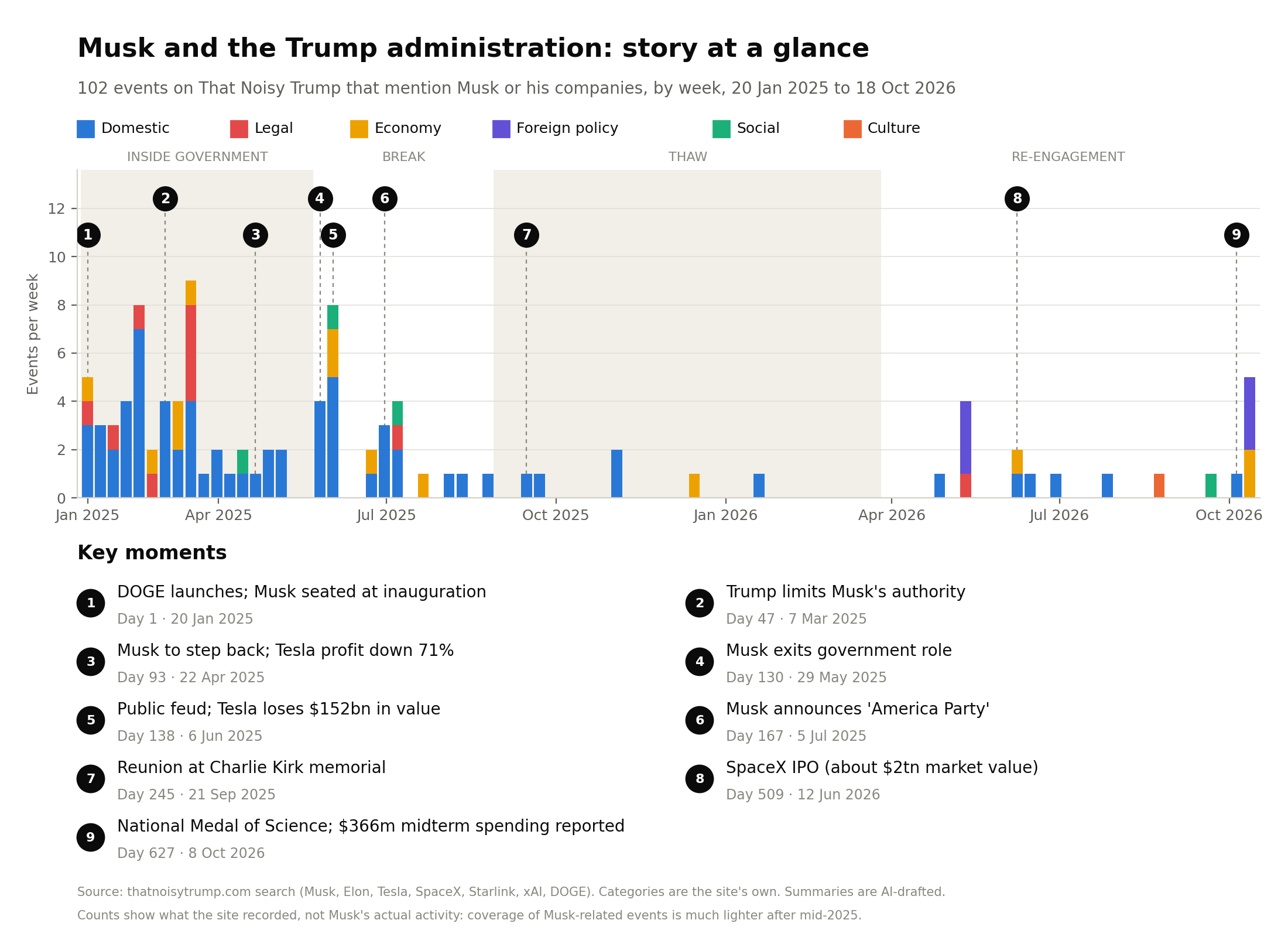
So why is he back? The question assumes a steady relationship, and the record shows an arc instead: inside government, a public break, a thaw, and a return. A better question is what Musk got, what he gave up, and what the pattern suggests. My short answer, which is opinion: business interests probably matter, but they don’t explain the whole pattern. The rest of this post shows how I got there.
What this evidence can and can’t show
I built a timeline of 63 events from That Noisy Trump, a tracker of Trump’s second term, and added 20 business, regulatory and contract events from other reporting. It records what happened and when. It doesn’t record what anyone intended.
So my standard is this: I treat a pattern as suggestive only if it survives the evidence against it, which I set out in “The case against”. Where the timing overlaps, I say “overlaps” or “was followed by”, not “because”. Two caveats on the data. The site’s coverage of Musk thins after mid-2025, so event counts reflect what the site recorded, not how active Musk was. And event summaries on the site are AI-drafted, so I’ve linked the original reporting for every claim.
The arc
Inside government (20 January to May 2025)
Musk co-led the Department of Government Efficiency (DOGE). It was given full access to the federal payment system, led mass layoffs, and lost several court fights, including one over Social Security records. By March, Trump had limited Musk’s authority after clashes in a Cabinet meeting. In April, Tesla reported a 71% fall in profit and Musk said he would pull back from DOGE. He left on 29 May.
The break (June to July 2025)
Musk called Trump’s tax bill a “disgusting abomination”. The feud followed, and on 5 July he announced an “America Party”.
The thaw (August 2025 to early 2026)
By August, disclosures showed Musk had given $5m to a Trump-aligned super PAC. On 21 September the two were photographed together at the Charlie Kirk memorial, their first public appearance together in months.
Re-engagement (2026)
Musk traveled with Trump to the Beijing summit in May, and SpaceX went public on 12 June. His political spending ramped up: he has reportedly spent about $366m this cycle, about $276m of it since July 2026. For comparison, CNN reported that he spent more than $290m on the 2024 election. In October, Trump gave him the National Medal of Science.
The case that business interests matter
Three kinds of evidence point this way. For each, I give the strongest examples and then what they don’t prove.
1. Enforcement that slowed. In May 2025, NBC News found that the Justice Department had dropped a case against SpaceX, the Labor Department had canceled its civil rights review of Tesla, and in more than 40 other federal matters regulators had taken no public action for months. A UCLA law professor said agencies might be slow-walking them. The SEC’s case over Musk’s late disclosure of his Twitter stake, filed in January 2025, settled in May 2026 for a $1.5m penalty with no admission of wrongdoing.
What this doesn’t show: the NBC review describes inaction, which is different from proof that anyone halted a probe. The White House said officials would comply with conflict-of-interest rules, and staffing cuts could explain some of the quiet. The SEC’s Twitter case also cuts both ways: the agency had alleged that the late disclosure cost other shareholders at least $150m, yet the settlement included no repayment to shareholders, and Musk’s lawyer said he was cleared of the late-filing issues. A separate jury found Musk liable in March 2026 for defrauding Twitter shareholders.
2. Approvals and rule changes. The administration moved in March 2025 to overhaul a $42.5bn rural internet program, with Starlink a likely beneficiary. In June it revised the program’s rules to be technology-neutral, and Starlink was later provisionally awarded roughly $710m across 42 states, by my tally of Telecompetitor’s list as of 3 December 2025. The FAA approved more Starship launches, and the FCC approved more Starlink satellites and a large EchoStar spectrum sale.
What this doesn’t show: the FAA’s review of Starship launches at Kennedy Space Center followed the standard environmental process, with a draft environmental impact statement in August 2025, a public comment period that closed in September 2025, and a final statement expected in early 2026. Some rule changes, such as the self-driving framework, apply to the whole industry, and the broadband rule change applied to every provider, not only Starlink. The broadband awards are also provisional, and the list I counted from was still being updated.
3. Contracts. In April and May 2026, SpaceX won three Golden Dome awards: a $57m crosslink demonstration that coverage tied to Golden Dome, a $2.29bn data network backbone, and a $4.16bn tracking network. The two large ones total about $6.45bn. SpaceX went public on 12 June at about $1.77tn, closing the day near $2.1tn. xAI also won a $200m Pentagon contract in July 2025, and in June 2026 the Justice Department moved to intervene on xAI’s sidein an NAACP pollution suit and asked the court to dismiss it.
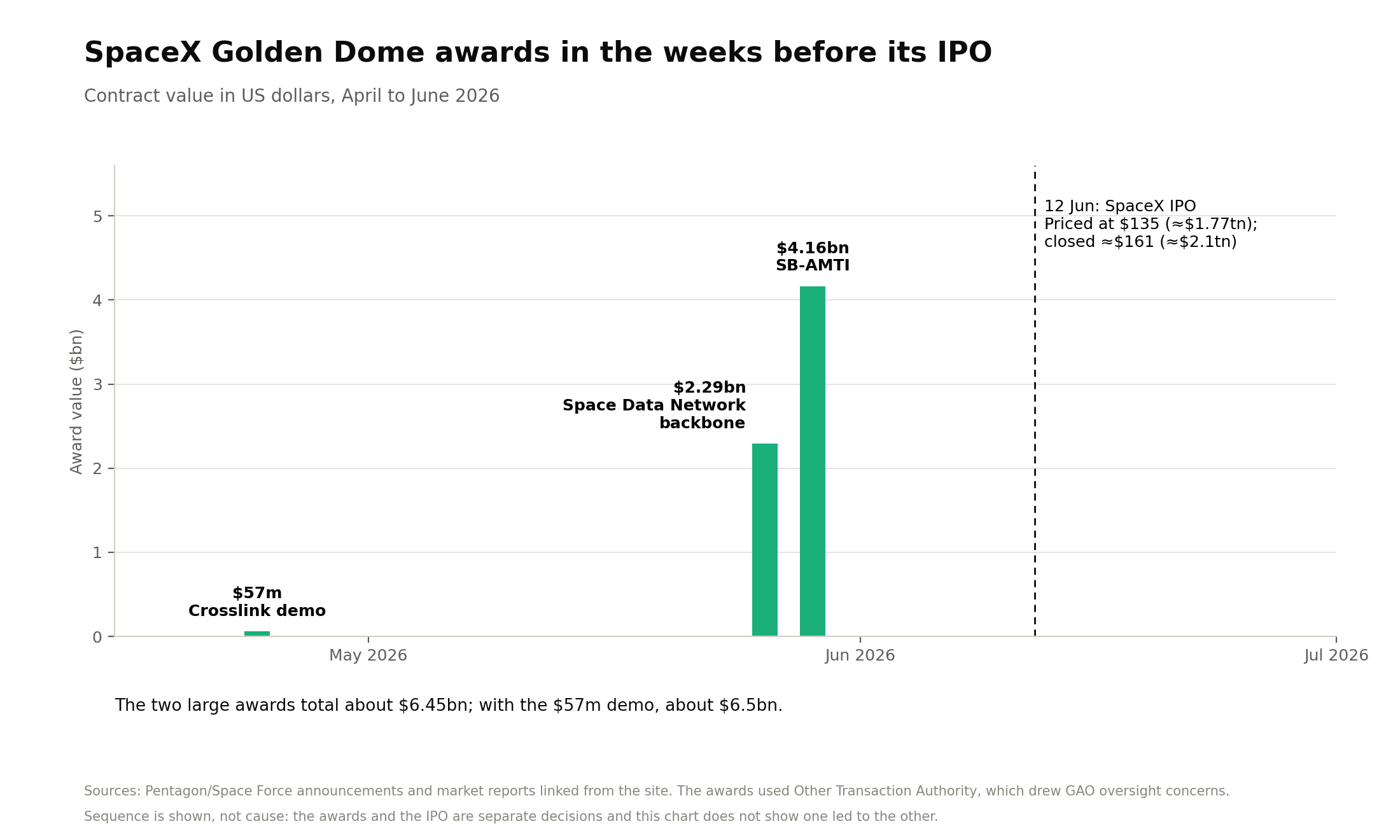
What this doesn’t show: the awards used a procurement route (Other Transaction Authority) that the GAO has flagged for oversight concerns, but that is a concern about process, not evidence of favoritism. The awards and the IPO are separate decisions. Contracts of this kind take months to negotiate, so the timing may be a coincidence.
The case against
If Musk were simply buying favorable treatment, you would expect the administration to avoid policies that hurt his companies. It didn’t.
The $7,500 EV tax credit ended for vehicles acquired after 30 September 2025, and the budget law cut fuel-economy penalties to zero, which undercuts the market for the regulatory credits Tesla sells. JPMorgan estimated the loss to Tesla at about $1.2bn a year. Musk, who said in 2024 that removing subsidies “will only help Tesla”, attacked the bill. Tesla told the government in March 2025 that the trade war could harm EV makers.
Trump pulled Jared Isaacman’s nomination to run NASA two days after Musk left, though he later renominated him and the Senate confirmed him 67 to 30. NASA now backs both SpaceX and Blue Origin for the lunar lander, which limits SpaceX’s position. And federal scrutiny of Tesla continued: NHTSA opened new probes of Full Self-Driving and robotaxis in 2025 and 2026.
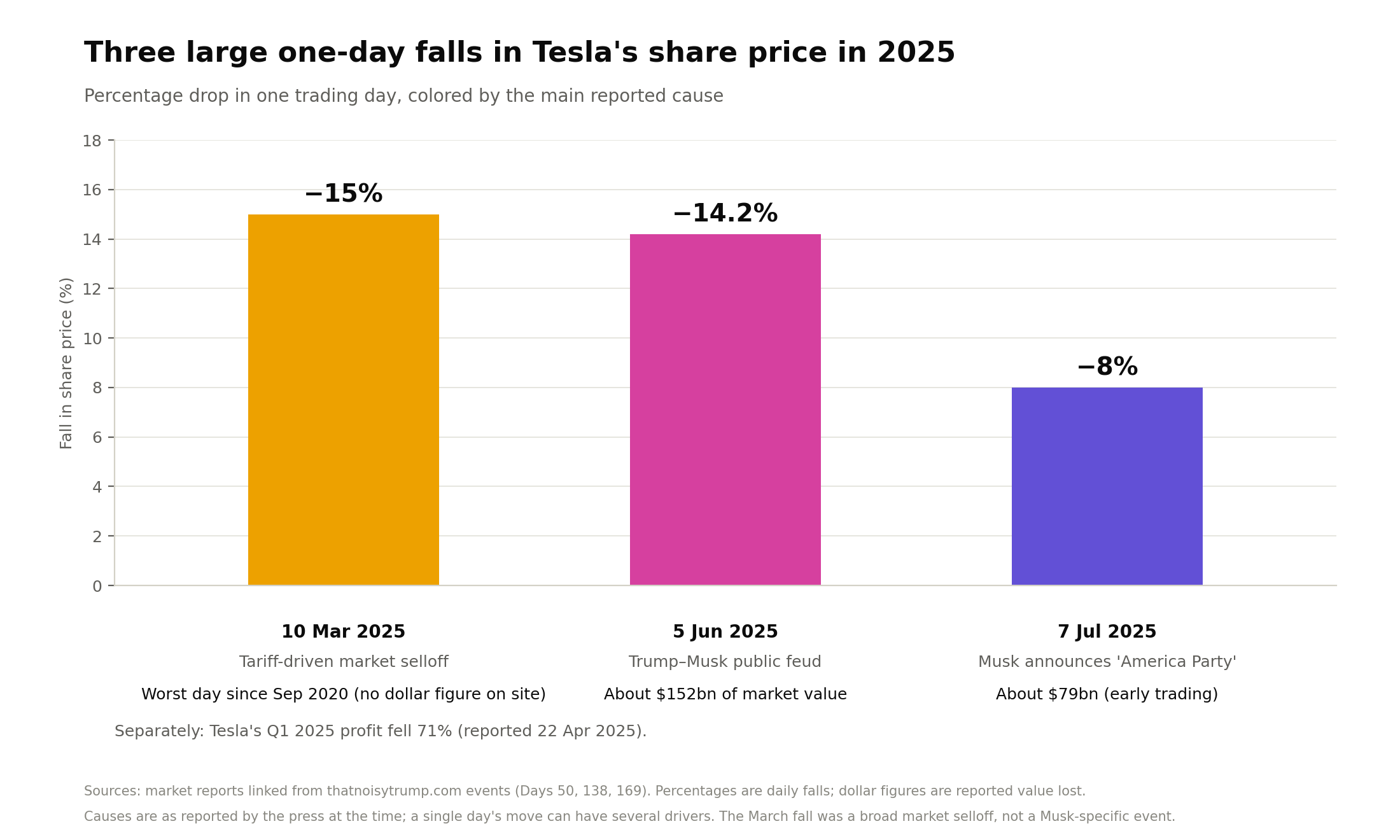
Then there is the cost to Tesla itself. Its shares fell 15% on 10 March, though that was a broad tariff-driven selloff. They fell 14.2% on 5 June in the feud, and 8% on 7 July after the America Party was announced, wiping about $79bn. Analysts linked steep falls in sales and profit to his role in the administration, and a Reuters report tied the fall in European sales to his support for far-right parties.
Any theory that business interests drive Musk has to explain why he accepted these costs.
Other explanations
Ideology and conviction. Musk backed Germany’s AfD and other European far-right parties (NPR), and his spending is large. Reports describe the roughly $366m as the largest known donation total of this cycle. Of the $276m spent since July 2026, $158m went to the Senate Leadership Fund and, by press reports, about $76m to his own America PAC, with smaller amounts to the Congressional Leadership Fund, the Republican Governors Association and other groups.
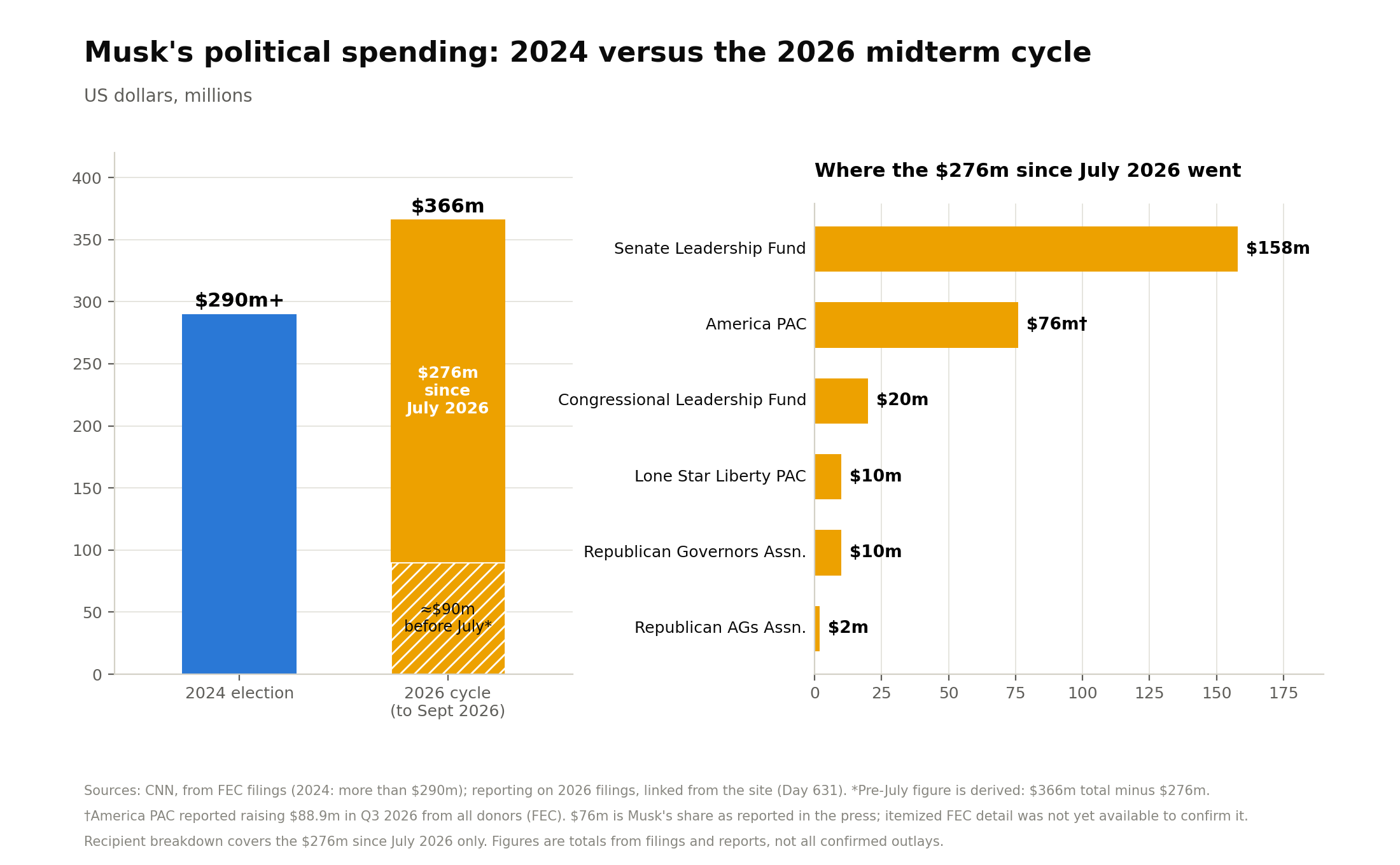
Supports it: the scale of the spending and the willingness to take Tesla losses. Weakens it: he broke with Trump over a tax bill, which suggests his commitments are not simply to Trump, and ideology alone doesn’t explain the timing of the return.
Power and access. DOGE gave Musk direct influence over federal agencies, and access was greatest in early 2025. Weakens it: he chose to leave in May 2025 and then fought Trump publicly, which is not what someone who valued access above everything would do.
Policy agreement. Musk may simply agree with the administration on regulation, immigration, and government size. Supports it: DOGE’s goals matched his stated views. Weakens it: he called the signature tax bill “insane and destructive”.
Testing the theories against the pattern
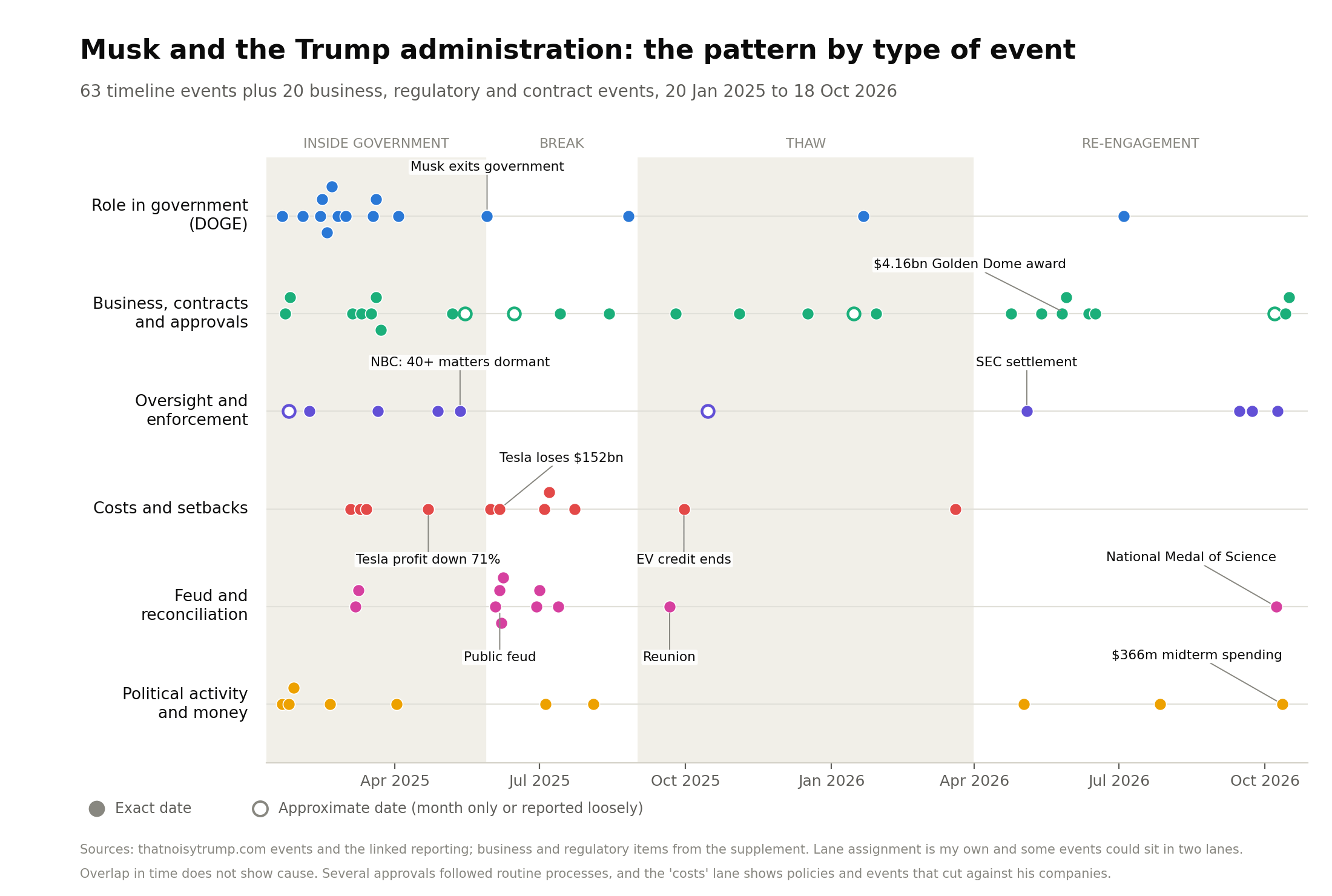
Each explanation predicts something different, so I checked.
If business interest drives him, his moves should track his companies’ exposure. They partly do: he left government after Tesla’s profit fell 71%, and the large 2026 spending followed the SpaceX contracts and IPO. But the break itself cut against his business interests, since it cost Tesla $152bn in a day and invited threats to his contracts.
If ideology drives him, why break over a tax bill, and why come back to Trump?
If access drives him, why leave at the point of greatest access?
No single explanation fits every event. Business interest explains the return better than the break. Ideology explains the break better than the return. That is a mixed result, with no single answer.
My verdict
The evidence fits a mixed answer. Business interests probably matter, and the approvals, contracts and quiet enforcement are the kind of benefits any company with large government exposure would want to protect. But the 2025 break, the Tesla losses, and policies like the EV credit ending show that these interests don’t explain the whole pattern. I’d put my confidence at moderate. I could be wrong about the weight of each factor.
What we don’t know
We don’t know what was said in private. We don’t know the real status of the dormant federal matters, or whether the approvals would have happened anyway. Several items remain open: an FCC vote on auctioning spectrum for direct-to-device satellite services, scheduled for 29 October 2026 (it has not yet happened as of writing), the NHTSA matters, and oversight of the Golden Dome program.
What would change my mind: court records or agency decisions on the pending matters, a clearer account of how the Golden Dome awards were decided, or Musk’s own statements about why he returned.
Sources and method
I built the timeline by searching That Noisy Trump for Musk, Tesla, SpaceX, Starlink, xAI and DOGE, which returned 102 events, 63 of which are used here. I added regulatory, contract and counter-evidence from separate reporting. Event summaries on the site are AI-drafted, so I checked key claims against the linked reporting. Where a figure comes from a single outlet, I’ve named it.
Appendix: Musk and the Trump administration, a sourced timeline
This timeline supports the post. It lists 63 events from 20 January 2025 to 16 October 2026, taken from a search of That Noisy Trump for Musk, Tesla, SpaceX, Starlink, xAI and DOGE. Each entry links to the original reporting and to the event page on the site. Day numbers count from 20 January 2025 (Day 1). Event summaries on the site are AI-drafted and have been checked against the linked reporting. The timeline records what happened and when; it makes no claim about why.
Phase 1: Musk inside government (20 Jan – Apr 2025)
Day 1 · 20 Jan 2025: A lawsuit was filed moments after the inauguration challenging DOGE, co-led by Musk, under federal transparency rules. (Guardian · site)
Day 1 · 20 Jan 2025: Musk, Zuckerberg and Bezos were seated prominently ahead of cabinet picks at the inauguration. (Guardian · site)
Day 3 · 22 Jan 2025: Trump announced a $500bn AI initiative, ‘Stargate’; Musk, Sam Altman and Satya Nadella then disputed its details and feasibility in public. (Guardian · site)
Day 5 · 24 Jan 2025: Musk drew condemnation after a gesture critics described as a Nazi salute at an inauguration celebration event. (NPR · site)
Day 6 · 25 Jan 2025: Trump was said to be exploring options to save TikTok, with Musk among potential buyers discussed. (BBC · site)
Day 8 · 27 Jan 2025: Musk faced criticism for backing Germany’s AfD, including hosting its leader on X. (NPR · site)
Day 14 · 2 Feb 2025: DOGE was granted ‘full access’ to the federal payment system. (Guardian · site)
Day 25 · 13 Feb 2025: Mass layoffs began; termination notices went to the Education Department and the CFPB. (Guardian · site)
Day 26 · 14 Feb 2025: Agencies were directed to fire probationary employees, potentially up to 200,000 people. (Guardian · site)
Day 29 · 17 Feb 2025: The IRS was reported to be preparing to give DOGE access to taxpayer data systems. (Guardian · site)
Day 31 · 19 Feb 2025: Trump and Musk gave a joint Fox News interview with Sean Hannity. (AP · site)
Day 32 · 20 Feb 2025: A federal judge rejected a union bid to halt the DOGE-led firings. (Guardian · site)
Day 36 · 24 Feb 2025: A federal judge blocked the Education Department and OPM from sharing sensitive personal data with DOGE. (Guardian · site)
Day 41 · 1 Mar 2025: An email indicated a Musk ally at the GSA was moving to close the IRS office running the free tax filing program. (Guardian · site)
Day 44 · 4 Mar 2025: Musk’s promotion of far-right parties in Europe was cited as a contributing factor in a sharp fall in Tesla sales there. (Reuters · site)
Day 45 · 5 Mar 2025: The White House announced plans to overhaul a $42.5bn Biden-era rural internet program, with Starlink positioned as a likely beneficiary. (Guardian · site)
Day 47 · 7 Mar 2025: Trump imposed new limits on Musk’s authority after tensions spilled out in a Cabinet meeting. (NBC News · site)
Day 49 · 9 Mar 2025: Marco Rubio and Musk clashed during a Cabinet meeting, per the New York Times. (The Hill · site)
Day 50 · 10 Mar 2025: Tesla shares fell 15%, their worst day since September 2020, amid wider market declines over tariffs. (Guardian · site)
Day 51 · 11 Mar 2025: Trump displayed Tesla vehicles at the White House, said he would buy one, and called boycotts of Tesla ‘illegal’. (NBC News · site)
Day 54 · 14 Mar 2025: Tesla warned the US government that Trump’s trade war could harm EV companies. (Guardian · site)
Day 57 · 17 Mar 2025: A US official said the administration would re-evaluate Biden-era rural broadband programs, a move likely to benefit Starlink. (Guardian · site)
Day 58 · 18 Mar 2025: A judge ruled the effort to shut down USAID, directed by DOGE, likely violated the Constitution. (Guardian · site)
Day 60 · 20 Mar 2025: A judge blocked DOGE from accessing Social Security records, calling it a ‘fishing expedition’. (Guardian · site)
Day 60 · 20 Mar 2025: Attorney General Pam Bondi announced charges against three people over destruction of Tesla vehicles and charging stations. (Guardian · site)
Day 61 · 21 Mar 2025: Trump acknowledged Musk has conflicts of interest and said classified plans for a potential war with China would not be shared with him. (Guardian · site)
Day 63 · 23 Mar 2025: The New York Times reported Musk was positioned to profit from billions in new government contracts through SpaceX. (NYT · site)
Day 73 · 2 Apr 2025: The Wisconsin Supreme Court race, in which Musk had been heavily involved, was won by the liberal candidate, Susan Crawford. (Guardian · site)
Day 74 · 3 Apr 2025: Vice President Vance said Musk would step back from DOGE while remaining a ‘friend and adviser’. (Guardian · site)
Day 93 · 22 Apr 2025: Musk said he would pull back from DOGE from May; Tesla profits fell 71%, with analysts attributing part of the decline to the brand damage from his government role. (Guardian · site)
Day 99 · 28 Apr 2025: A Senate report estimated DOGE-related conflicts of interest at about $2.37bn, calling that a ‘conservative estimate’. (Guardian · site)
Phase 2: Exit and the first break (May – Jul 2025)
Day 108 · 7 May 2025: The administration planned to end government research on space pollution, which the Guardian said benefits SpaceX/Starlink by avoiding future regulation. (Guardian · site)
Day 130 · 29 May 2025: Musk announced his exit from his government role after a public disagreement with Trump over a tax bill. (Guardian · site)
Day 132 · 31 May 2025: Trump withdrew his nomination of Jared Isaacman, a Musk associate and SpaceX customer, for NASA administrator. (CBS News · site)
Day 135 · 3 Jun 2025: Musk called Trump’s tax bill a ‘disgusting abomination’ and said it would grow the deficit by $2.5tn. (Guardian · site)
Day 138 · 6 Jun 2025: Trump and Musk fought publicly; Trump said Musk had ‘lost his mind’, Musk called for impeachment and threatened to decommission SpaceX’s Dragon spacecraft. (Guardian · site)
Day 138 · 6 Jun 2025: Tesla’s share price fell 14.2%, wiping about $152bn off its market value; Trump threatened to strip subsidies from Musk’s companies. (Guardian · site)
Day 139 · 7 Jun 2025: Trump said the relationship was over and warned of ‘serious consequences’ if Musk funded Democrats. (BBC · site)
Day 140 · 8 Jun 2025: Trump threatened to cut off federal contracts to Musk’s companies. (NYT · site)
Day 161 · 29 Jun 2025: Musk called the domestic policy bill ‘utterly insane and destructive’ and said passing it would be ‘political suicide’. (Guardian · site)
Day 163 · 1 Jul 2025: Trump threatened potential deportation; Musk vowed to unseat lawmakers backing the bill. (Guardian · site)
Day 167 · 5 Jul 2025: Musk announced plans for a new political party, the ‘America Party’. (Guardian · site)
Day 169 · 7 Jul 2025: Tesla shares fell 8%, wiping $79bn off its value, as investors worried the party venture would distract Musk. (ABC News · site)
Day 175 · 13 Jul 2025: Musk criticized Trump’s handling of the Epstein files, telling him to ‘just release the files as promised’. (The Hill · site)
Day 185 · 23 Jul 2025: Tesla reported steep drops in sales and profit that analysts linked to Musk’s role in the administration. (Guardian · site)
Phase 3: The thaw (Aug – Dec 2025)
Day 197 · 4 Aug 2025: Disclosures showed Musk donated $5m to a Trump-aligned super PAC. (The Hill · site)
Day 207 · 14 Aug 2025: Trump ordered relaxed environmental review rules for rocket launches, potentially benefiting SpaceX and Blue Origin. (Guardian · site)
Day 219 · 26 Aug 2025: A whistleblower alleged DOGE staff uploaded Social Security data on hundreds of millions of Americans to a vulnerable cloud server. (Guardian · site)
Day 245 · 21 Sep 2025: Trump and Musk were photographed together at the Charlie Kirk memorial service, their first public appearance together in months. (NYT · site)
Day 289 · 4 Nov 2025: Trump reversed himself and said he would renominate Jared Isaacman, a Musk ally, to lead NASA. (Guardian · site)
Day 332 · 17 Dec 2025: The Senate confirmed Isaacman as NASA administrator, 67-30. (Guardian · site)
Phase 4: Re-engagement (2026)
Day 367 · 21 Jan 2026: A DOJ court filing revealed DOGE improperly shared sensitive Social Security data; the administration acknowledged the violation. (Guardian · site)
Day 468 · 2 May 2026: Trump endorsed Andy Barr for Senate in Kentucky after Musk-backed candidate Nate Morris exited the race following a meeting with the president. (NYT · site)
Day 479 · 13 May 2026: Musk traveled with Trump to Beijing for the summit with Xi Jinping, alongside Tim Cook and other tech executives. (Guardian · site)
Day 509 · 12 Jun 2026: SpaceX completed its IPO, raising about $75bn at a valuation above $2tn. (AP · site)
Day 513 · 16 Jun 2026: The Justice Department moved to intervene on xAI’s side in an NAACP pollution suit over methane-gas turbines at a Mississippi data center, and asked the court to dismiss the case (motion filed 15 Jun per the docket; the Guardian reported it on 16 Jun). (Guardian · site)
Day 531 · 4 Jul 2026: DOGE ceased operations when its charter expired on 4 July. (Politico · site)
Day 554 · 27 Jul 2026: After a tough Economist interview on race, USAID and misinformation on X, Musk lashed out at the interviewer. (Washington Post · site)
Day 612 · 23 Sep 2026: Trump disclosed millions of dollars in stock holdings in tech and AI firms including Microsoft, Nvidia and SpaceX. (BBC · site)
Day 627 · 8 Oct 2026: Trump awarded Musk and other tech executives National Medals of Science; reporting describes Musk and Trump as reconciled after the 2025 feud. (Al Jazeera · site)
Day 631 · 12 Oct 2026: Musk was reported to have spent about $366m to support Republican candidates and groups ahead of the 2026 midterms, the largest known donor. (Al Jazeera · site)
Day 633 · 14 Oct 2026: Ukraine accused SpaceX of throttling Starlink terminals without warning, limiting its ability to counter Russian drones. (Al Jazeera · site)
Day 635 · 16 Oct 2026: Trump denied imposing restrictions on Ukraine’s Starshield access; reports said Pentagon officials ordered speed reductions. (BBC · site)
Musk got everything!! All our information. Got rid of his competitors. And got all the government contacts - without bidding for them - at top dollar, all funded by American tax dollars!! WAKE UP AMERICA!!!